Port of the Islands
by Denise Wauters
The pool is still there. If you pull off Tamiami Trail at the Port of the Islands resort and walk around the back, you can stand at the edge of it. It is deeper than any pool you are likely to swim in today, a leftover from a stretch of Port of the Islands’ history when nobody worried about that sort of thing. It looks like something out of a 1970s Miami movie. And it is one of the last physical pieces of one of the largest scams in Florida history.
The whole thing started in 1967. Two brothers from Baltimore, Leonard and Jack Rosen, had spent the late 1950s figuring out that you could fly people down from the Midwest, show them a piece of Florida swamp, and convince them to buy it. Their first big project was Cape Coral. Cape Coral actually worked. The roads got built, the canals got dug, the houses came, and a real community took shape. The Rosens looked like geniuses.
Then they got greedy.
The Setup
Just southeast of Cape Coral, the Rosens’ company, Gulf American Land Corporation, platted 175 square miles of swampland and called it Golden Gate Estates. Lots that were worth about three thousand dollars were sold to out-of-state buyers for more than fifteen thousand. The pitch was that this was going to be the next Cape Coral. The reality was that there were no utilities, no public services, no schools, no shopping centers, and no plan to ever build any of them.
To make the pitch convincing, Gulf American needed a stage. So they built one.
In 1967, on the south side of Tamiami Trail, about twenty-three miles southeast of Naples, they constructed Remuda Ranch Grants. You know it today as Port of the Islands. The complex straddled the highway. The south side held a marina, a boatel, a deep swimming pool, and luxury rooms. A boatel, in case you have not heard the word, is a hotel where you tie your boat up at your room. Very 1960s, very Florida, very much the kind of thing that made buyers feel like they were stepping into the future.
The north side, hidden behind the trees off what is now Union Road, held the more elaborate building. A Spanish-mission-style hotel with a big ballroom, a skeet and trap shooting range, riding stables, hunting kennels, a quarter-mile race track, and camping grounds with water and electric. Everglades City School proms and formal events were held in that ballroom. Plenty of people in town remember those nights.
This was where the marks were brought.
The Pitch
Gulf American flew prospective buyers down on the company’s own airline, free of charge. They put them up at Remuda Ranch. They fed them. They walked them through slideshows of Cape Coral and let them assume Golden Gate Estates would look the same way one day. To make the development look like it was actually happening, they erected life-size facades of earth-moving equipment off in the distance. Buyers could look out across the swamp and see “construction” underway.
There was no construction.
In the lobby, big photographs hung on the walls. Pool parties. Parades. Crowds of people, some of them recognizable faces from the era, all of them apparently having a wonderful time at Remuda Ranch. Famous names were written on the back of some of them. Years later, after the property had changed hands and started its long decline, the photos were moved into back-room storage. Some of them are still there today, tucked away in a back room at the resort that survived.
The photos were part of the same machine as the fake earth-movers. Bring well-known people to the property, photograph them by the pool, hang the pictures where buyers would see them, and the place looks like somewhere you want to put your money. By 1967, Florida had seen enough of this to step in. The state ordered Gulf American to suspend sales while it investigated.
The Collapse
The Rosens sold Gulf American in 1969 for more than $200 million and walked away…rich! The new owners tried to keep the operation going, but the math never worked. The lots were too small to build on, and there were too many of them on land that could never support that many homes. The county eventually required at least 2.25 acres before anyone could put up a house. By 1974, only ten percent of Golden Gate Estates had ever been built on. The new owners filed for bankruptcy protection in 1975. They kept the doors open for a few more years while they tried to restructure, but Remuda Ranch closed for good in 1979.
In the years that followed, the abandoned roads of Golden Gate Estates went quiet in a different way. Local stories from that time describe small planes flying in from South America at night, landing on the empty grid that Gulf American had carved into the swamp, unloading cargo nobody talked about, and disappearing back into the dark. Documentation is thin. Rumors are not. The Everglades City area is no stranger to that history. You can read more about that side of things in our coverage of how marijuana smuggling changed Everglades City.
When General Acceptance Corporation’s bankruptcy trustees finally sold the old Remuda Ranch in February 1980, the buyer was a development partnership led by Bill Ray of Newport Beach, California. The sale covered 560.79 acres on both sides of Tamiami Trail, including both hotel complexes. The price was $2,708,597, financed by the bankruptcy trustees themselves rather than paid in cash. Ray’s partnership renamed the area Port of the Islands and, starting in 1984, began a real residential build-out that by all accounts was making it work. Then Ray died in 1991. His family auctioned off the remaining land in pieces in 1994, and that is when the original Remuda Ranch finally split apart into separate ownership
Two Hotels, Two Different Endings
After the 1994 split, the two hotels went in opposite directions.
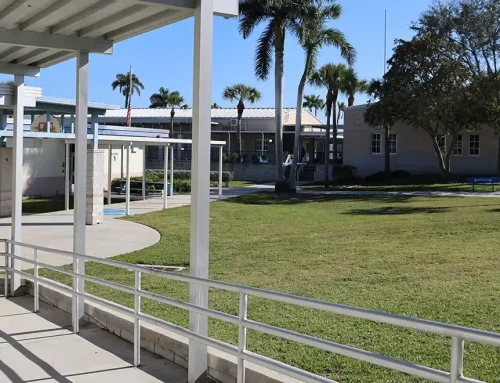
The one on the south side of Tamiami Trail, with the deep pool around back, is still there. You can see it from the highway. It has changed hands more times than anyone can easily count, and during the tight years some of the poolside suites were sold off individually just to keep the lights on. The hotel, the restaurant, the marina, and the ship’s store are all still operating, though as separate businesses now.
The one on the north side, the fancier hotel, the one with the ballroom, did not make it.
During Ray’s later years, the north hotel was operating under the name Regent Resort. After his family auctioned things off, the building changed hands again. Gopal and Nirmla Motwani bought it in 2002 for $275,000 and could not open it until 2006. By the time it shut for good in 2013, guests were complaining about broken locks, missing doorknobs, a deserted lobby, and a swimming pool that had been shut down after repeatedly failing state health inspections. The Motwanis owed more than half a million dollars in back taxes when they walked away.
In January 2020, Collier County took the property at a tax auction. Nobody bid. The county got it for $1,239.80 — seven acres on Tamiami Trail, the better-built hotel, the prom hotel, the one with the ballroom, for the price of a used refrigerator. The hotel itself was still standing, but only just. By then, weather and time had taken their toll. Locals riding past on bikes could see the shadows of what the place had been. The county spent another $388,444 tearing it down. The buildings came down in January 2021.
What Is Left
On the south side of Tamiami Trail, the marina, the ship’s store, and the hotel with the restaurant are still there. The pool is still around back. Beautiful as it always was, ringed with palms, still deep enough for a real dive. You don’t find that at hotels anymore.
On the north side, the story is shorter. The hotel is gone. The big campground that used to sit behind it, between the hotel and the gun ranges, is gone too. The gun ranges themselves, Gulf Coast Clays and Louland Gun Range, sit on the land that was originally part of the Remuda Ranch shooting grounds, where guests could compete at trap and skeet day and night. Of everything Remuda Ranch put on that property, the guns are what stuck.
Pull up a satellite map of Picayune Strand State Forest just to the north, and you can still see the empty grid of streets Gulf American carved into the swamp. The state has been steadily filling in those canals as part of one of the largest restoration projects in Florida, working to undo the damage the two brothers from Baltimore left behind.
And five years after the demolition, Collier County is now looking at proposals for what to do with the empty seven acres where the better hotel used to stand. Affordable housing is one of the options being considered. The county has asked staff to broaden the search and see what other ideas come in.
Oh, and one more thing Remuda Ranch left behind. A phrase you have probably said yourself, without ever wondering where it came from.
If you believe that, I’ve got some swampland in Florida to sell you.
You may also be interested in Tamiami Trail Turns 98 with a Birthday Celebration in Everglades City or How Marijuana Smuggling Changed Everglades City.