by Denise Wauters
If you’ve driven across South Florida, chances are you’ve been on Alligator Alley, even if nobody told you that’s what you were on. It’s the name for the stretch of Interstate 75 that runs about 80 miles straight across the Everglades, connecting Naples on the Gulf side to the Fort Lauderdale area on the Atlantic. One road, two coasts, and a whole lot of sawgrass in between.
There’s a story behind the name, and around here you’ll hear it told two ways.
The official version belongs to the interstate. Before I-75, that crossing was a two-lane toll road called the Everglades Parkway, or State Road 84. The American Automobile Association didn’t think much of it when it was being planned and started calling it “Alligator Alley” as a put-down, a road they figured was good for little more than the gators. The state liked the name anyway and made it official in 1966, two years before the road even opened. It stayed two lanes until they widened it into the I-75 you drive today.
Ask folks who’ve been here a while, though, and plenty will tell you the real Alligator Alley was never the interstate at all. It was U.S. 41, the Tamiami Trail, the older road that’s been crossing the Everglades since 1928, about thirty miles to the south. Anyone who’s driven 41 toward Miami knows why the name fits. The gators are right there along the canal, sunning on the banks, sometimes stretched out near the road like they own the place. To the people who grew up driving it, that was the original Alligator Alley, and the interstate just borrowed a name that was already famous.
Both stories are true in their own way.
Take the Tamiami Trail today (Hwy 41) and you’ll see why people feel the way they do. It doesn’t feel like a highway. It feels rustic. Wide open. Sawgrass stretching out in every direction, broken up by stands of trees rising just above the waterline.
Those stands of trees are called hammocks when they’re in the middle of a swamp — slightly higher ground where the animals gather to drink and live. Once you notice them, you start to understand how everything out here works. Where there’s a hammock, there’s life.
You’ll see birds lifting off in groups, turtles slipping into the water before you get too close, and alligators stretched out in the sun along the edges. Sometimes they’re right in the road and you just have to stop and wait. Thus “Alligator Alley.”
You don’t forget it — driving through and realizing you’re sharing the road with all of it. That’s the part that stays with you.
Most days, traffic is light. A few locals. Someone heading across the state to the keys. It’s quieter. Slower. More casual. The Trail isn’t a road you rush across. You slow down. You look around. You notice things.
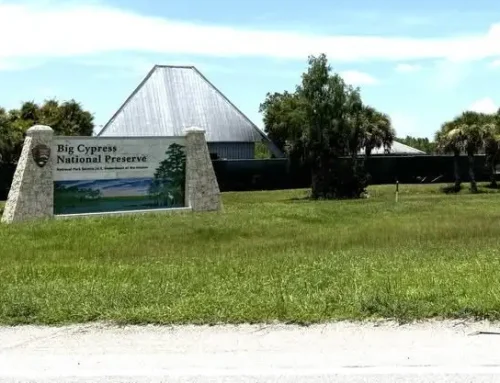
And there are places to stop, stretched out along the way. You can pull off at a boardwalk like Big Cypress Bend, walk the boardwalk, check out the artwork or simply sit in the rockers and take it all in.
If you’ve brought a kayak, there’s water to paddle. There are natural put-ins and worn fishing spots all along the road.
The Trail runs right past Ochopee and the heart of Big Cypress, and it’s got its share of quirky stops along the way — the smallest post office in the country, the Skunk Ape Headquarters, and the Clyde Butcher gallery. A side trip down Loop Road will put you somewhere a little wilder. Lots of people take their bike on this road.
Most people today hear Alligator Alley and think of Interstate 75, the straight shot between Naples and Fort Lauderdale. It moves you across the state fast, and that’s what it’s for. You’ll see sawgrass, big sky, maybe a gator in the canal if your eyes are sharp. It’s kind of like seeing it from an airboat — more about the ride than about what you came out here to see. The old road is the slower way, the one where you actually experience the Everglades.
That’s why, for plenty of folks who’ve been here a while, the old road is the one that holds the name. Not because of danger or drama, but because this drive reminds you, quietly and unmistakably, that you’re a guest.
You may also be interested in The Ten Thousand Islands of Florida or The History of the Tamiami Trail.
There’s a story locals know that doesn’t always get told right.
Before Interstate 75, before the fences and service plazas, there was a narrow road cutting across the Everglades. Two lanes, no rush, and more wildlife than traffic most days. That road is Old U.S. 41. And for a long time, that’s what people meant when they said Alligator Alley.
Drive it today and it doesn’t feel like a highway. It feels rustic. Wide open. Sawgrass stretching out in every direction, broken up by stands of trees rising just above the waterline.
Those stands of trees are called hammocks when they are in the middle of a swamp — slightly higher ground where the animals gather to drink and live. Once you notice them, you start to understand how everything out here works. Where there’s a hammock, there’s life.
You’ll see birds lifting off in groups, turtles slipping into the water before you get too close, and alligators stretched out in the sun along the edges. Sometimes they don’t move. Sometimes they’re right where the road and the Everglades meet, like they’ve always been there and always will be.
That’s where the name came from. Not from a sign. Not from a plan. Just from people driving through and realizing they were sharing the road.
Most days, you’re alone out here. Even during the day, traffic is light. A few locals. Someone heading across the state. Maybe someone who chose this road on purpose instead of the faster way. It’s quieter. Slower. More casual.
Old 41 isn’t a road you rush across. You slow down. You look around. You notice things.
There’s only one place to stop, and even that feels like it belongs there instead of interrupting the road. You can step out, walk a boardwalk, stand still for a minute and actually hear the Everglades around you.
If you’ve brought a kayak, this is where you launch and paddle. If you’re fishing, you come with a plan. This isn’t a place you pass through without thinking about it.
Most people today hear Alligator Alley and think of Interstate 75 — the straight shot between Naples and Fort Lauderdale. It’s a toll road built to move traffic quickly across the state, and it does exactly that. You drive on. You drive off. That’s it.
But it’s not the road that earned the name.
That belongs to the old one.
Rustic. Wide open. A little quirky. A little nostalgic. The kind of place where you can stop, step out, and feel like you’re actually in the Everglades instead of just passing over it.
That’s why the name Alligator Alley belongs here. Not because of danger or drama — but because this road reminds you, quietly and unmistakably, that you’re a guest.