Manatees are one of the most loved animals in Southwest Florida, and it’s easy to understand why. They move slowly, spend their days grazing, and have a calm presence that fits perfectly with our quiet backwaters. What most people don’t realize is how unusual their bones are. Beneath that rounded, gentle shape is a skeleton with features you won’t find in many other animals.
Manatees only have six neck bones. Most mammals, including humans, have seven. Because of this, manatees cannot turn their heads from side to side. When they want to look behind them, they rotate their whole body like a slow underwater pivot.
Their pelvic bones tell another part of the story. These small pieces aren’t attached to the rest of the skeleton. They are leftovers from a time when the ancestors of manatees lived on land. Today, they simply float inside the body without serving any useful purpose.
The ribs are just as unusual. Manatee ribs are completely solid and contain no marrow. Instead of making blood cells in the ribs like most mammals, manatees produce them in the sternum, where marrow still exists. The heavy ribs also help them stay balanced in the water while they feed.
Manatees have hyoid bones in the neck that are similar to the structure that forms the Adam’s apple in humans. Scientists are not certain what role these bones play today, but they remain part of the manatee’s anatomy even if they no longer serve a clear purpose.
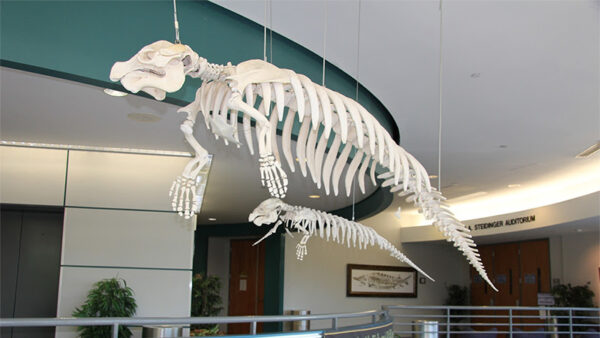
Manatee Bones Courtesy of FWC
Inside each flipper is a set of bones shaped much like a human hand. These finger-like bones give manatees a surprising amount of control. They use their flippers to steer through the water, pull themselves along the bottom in shallow areas, and bring food to their mouths.
The history behind those bones goes back more than 50 million years. The earliest ancestors of today’s manatees walked on land along warm coastlines and fed on plants much like small, heavy-built grazing animals. Over time, they followed the food into deeper water, and their bodies slowly changed to match their new environment. Legs shrank away, tails broadened into paddles, ribs grew heavier, and the hand bones that once supported them on land became the structure inside their flippers. All of these changes still show up in their skeleton today, a quiet reminder of how an ancient land mammal gradually became the gentle manatee that lives in Florida’s waters now.